
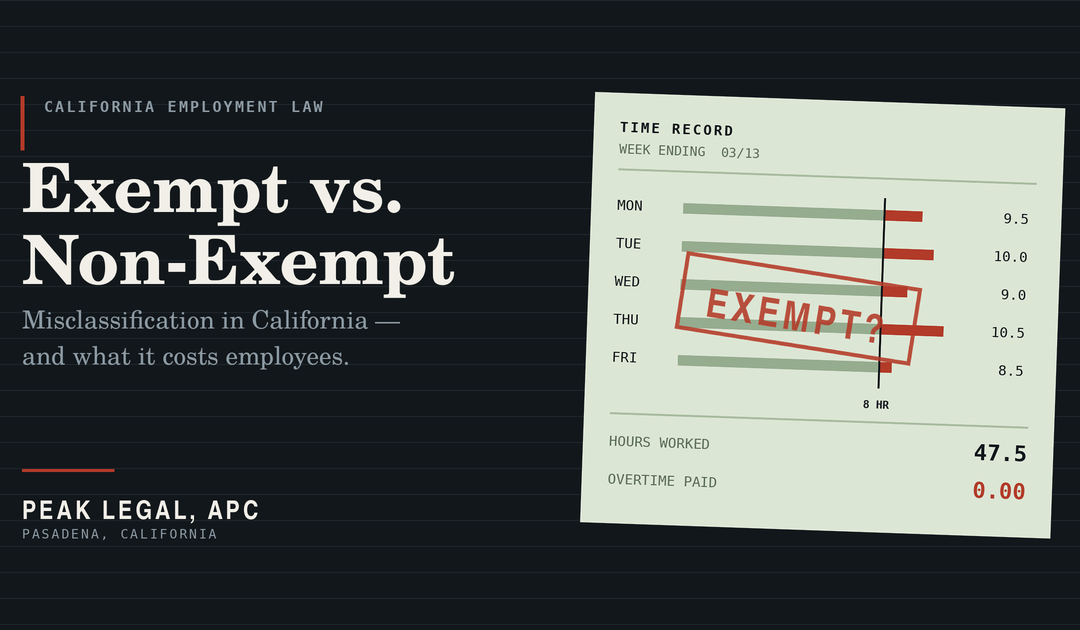
California has some of the nation’s strongest wage-and-hour protections, making the proper classification of employees an important issue for employers and employees alike. Whether an employee is properly classified as exempt or non-exempt can determine entitlement to overtime, meal and rest periods, accurate timekeeping, and other workplace protections.
Exempt vs. Non-Exempt Employees
Non-exempt employees are generally protected by California’s wage-and-hour laws. Depending on the circumstances, they may be entitled to overtime compensation, meal and rest periods, minimum wage protections, and payment for all compensable time worked. California’s overtime laws generally require overtime pay for qualifying hours worked over eight hours in a workday or 40 hours in a workweek, with double-time requirements in certain circumstances.
Exempt employees, by contrast, are excluded from certain wage-and-hour protections because they satisfy the requirements of a specific exemption. Common exemptions include executive, administrative, and professional exemptions. These exemptions can have detailed requirements concerning an employee’s salary, job duties, authority, and discretion. As of January 1, 2026, California's minimum salary threshold for many of these exemptions is $70,304 per year, based on twice the state minimum wage of $16.90 per hour.
Importantly, an employee’s job title or salary alone does not determine exempt status. An employee may be paid a salary and still be entitled to overtime if the employee does not satisfy the requirements of an applicable exemption.
How Misclassification Occurs
Misclassification generally occurs when an employer treats an employee as exempt even though the employee does not meet the applicable legal requirements. For example, an employee may have a managerial title but spend most of the workday performing non-managerial tasks and have limited authority or discretion. An employer may incorrectly classify a non-exempt employee as exempt in an effort to avoid paying overtime or complying with other wage-and-hour requirements.
California law also distinguishes between exempt and non-exempt classification and the separate issue of employee versus independent-contractor status. These are different legal questions and involve different legal standards. Employers therefore must carefully evaluate the actual nature of the employment relationship rather than relying solely on titles or contractual language.
Consequences of Misclassification
Improperly classifying a non-exempt employee as exempt can result in significant liability for an employer. Depending on the circumstances, an employee may seek unpaid overtime and other wages, compensation associated with meal and rest period violations, minimum-wage amounts, and other statutory remedies.
Misclassification can also result in inaccurate wage statements and inadequate timekeeping records. If an employee is treated as exempt, an employer may not maintain the records that would ordinarily be required for a non-exempt employee. Additional penalties may arise depending on the nature of the violations, including potential waiting-time penalties when qualifying wages are not timely paid at the end of employment.
California wage laws may also permit recovery of attorneys’ fees and costs in appropriate cases. As a result, the financial exposure associated with a misclassification dispute can extend well beyond the underlying unpaid wages.
Evaluating a Potential Misclassification Claim
For employees evaluating a potential misclassification claim, relevant evidence may include pay stubs, time records, schedules, job descriptions, emails, employment policies, and communications regarding job duties and hours worked. The employee’s actual day-to-day responsibilities can be especially important in determining whether an exemption applies.
A misclassification claim may also involve broader wage-and-hour issues, particularly where multiple employees were subject to the same classification practices. Depending on the circumstances, claims may be pursued individually or through class or representative proceedings.
What Employees Should Consider
Employees who believe they have been misclassified should preserve relevant employment records and document their actual work schedules and responsibilities. Pay records, schedules, emails, job descriptions, and communications concerning hours worked may be important in evaluating a potential claim.
California wage claims can be subject to specific deadlines and procedural requirements. Issues such as arbitration agreements, statutes of limitations, and potential representative claims may also affect how a case proceeds. Consulting with experienced California employment counsel can help determine whether a potential misclassification claim exists and what remedies may be available.
If you believe an employee has been improperly classified or are facing a potential California wage-and-hour claim, experienced employment counsel can help evaluate the circumstances and determine the appropriate course of action.
🚀 Seeking Legal Guidance on Employment Law? – Unsure if your workplace concerns fall under California's employment laws? Let Peak Legal help you navigate the complexities of your situation with a tailored consultation.
📧 Email Your Concerns! – Have a detailed scenario or specific questions? We're here to listen and provide the advice you need. Reach out to us at info@peaklegalca.com. Your legal solution is just an email away.